
Liv Grace
5 Min Read
Understanding Fuelling TDEE and your Metabolism
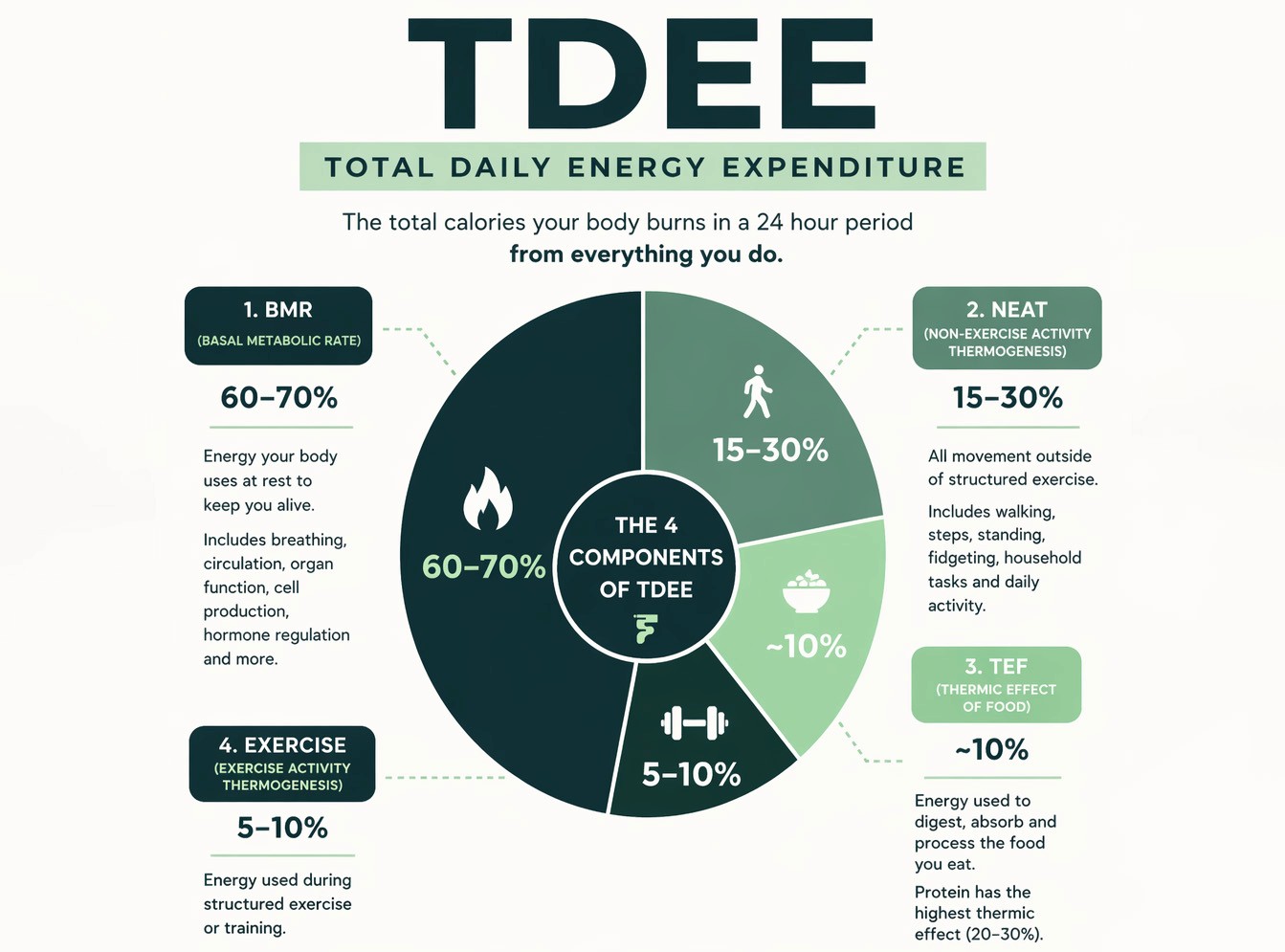
Full TDEE chart - Click here
To improve your physique, energy and overall health, it's crucial to understand how your body uses energy.
This is where TDEE (Total Daily Energy Expenditure) and metabolism come into play...
WHAT IS TDEE?
TDEE stands for Total Daily Energy Expenditure
It is the total number of calories your body burns in a day from everything you do.
This includes
Staying alive (breathing, organs functioning)
Moving throughout the day
Training
Digesting food
This is the foundation of fat loss, maintenance and muscle gain as well as optimising performance.

HOW MUCH ENERGY DOES YOUR BODY REQUIRE?
Your energy needs are individual and influenced by
Muscle mass
Activity levels
Lifestyle
Age and sex
This is why two people can eat the same thing and get completely different results
WHAT MAKES UP TDEE? (WITH % BREAKDOWN)
Your TDEE is made up of four key components
1. BMR (Basal Metabolic Rate) ~60–70%
The energy your body uses at rest
This is your largest contributor and is influenced by muscle mass, genetics and body size. Think breathing, cell and organ function, just existing at rest to keep you alive!!!
2. NEAT (Non-Exercise Activity Thermogenesis) ~15–30%
All movement outside of training!
Steps, walking, daily activity, work, thinking picking up a remote or putting away dishes.
This is one of the most underrated drivers of energy use!
3. TEF (Thermic Effect of Food) ~10%
Energy used to digest food! Yep it cost the body energy to have energy!
Protein has the highest thermic effect.
This means it requires more energy to break down; about 30% of the calories in protein are used just to unlock it to the body.
Carbs and Fats being signifcantly easier for the body to use without it costing alot of energy.
4. Exercise Activity ~5–10%
Your structured training and workouts!
Often overestimated....
Training is important, but it’s not the biggest contributor to daily energy burn...
This is where resistance training actually influences BMR the most by creating and keeping expensive cells that need more energy and calories at rest.... MUSCLE!
SO....WHAT IS METABOLISM?
Metabolism is the all chemical reactions in your body that keep you alive
It happens every second of every day.
And it is adaptive, so it can indeed speed up or slow down. How effectively the body uses energy and facilitates these reactions.
This means it responds to your environment
In a calorie surplus → metabolism can increase (upregulation)
In a calorie deficit → metabolism can decrease (downregulation)
This is called metabolic adaptation.
WHAT YOU CAN CONTROL VS WHAT YOU CAN’T
You have less control over
BMR (genetics, age, body composition) 60-70%
You have more control over the remaining 30-40%.
NEAT (steps, daily movement)
Exercise
Food choices and intake
HOW THIS RELATES TO YOUR NUTRITION
Understanding this changes everything!
Instead of
letting our feelings or energy levels guide our movement like NEAT (if we are dieiting it will convince us to be slower...)
consistently dieting and under-eating
guessing meal portions protein macros calories
Think...
Structured meals
Adequate protein
Consistent intake
Sustainable calorie targets
Because your body responds to what you do consistently!
IN SUMMARY!
TDEE and metabolism are the foundation of how your body uses and responds to energy.
TDEE is the total amount of calories your body burns each day
Made up of BMR, NEAT, TEF and exercise
Metabolism is the system that drives how your body
produces, uses and adapts to that energy
OTHER KEY TAKEAWAYS...
Your body requires energy to function, train and recover and energy balance over time determines fat loss, maintenance or muscle gain
BMR makes up the largest portion of energy expenditure.
NEAT is one of the most impactful and controllable factors!
Protein supports metabolism by retaining muscle mass and increasing the thermic effect.
Metabolism is adaptive, not broken! It's about creating regulation and making it work with us not against us.